Skip to content
Decision-ready map
(1) What it is
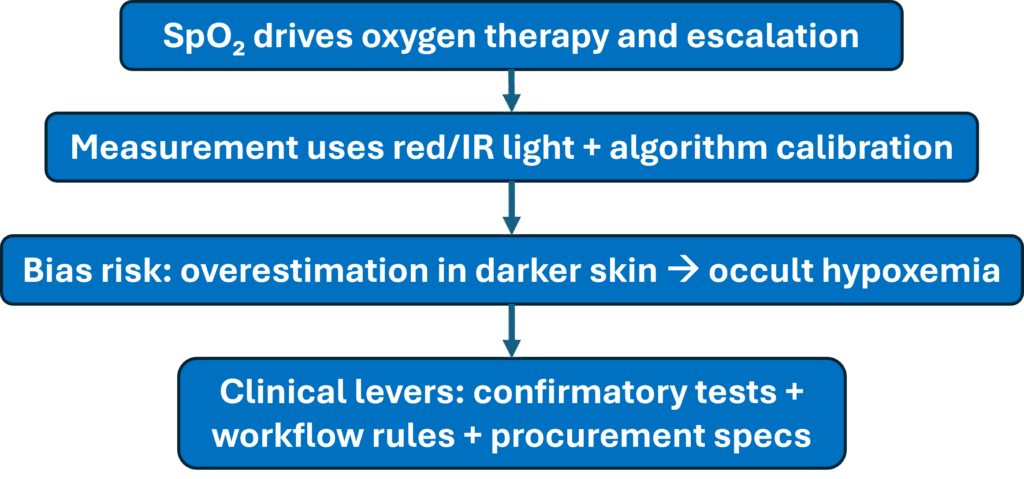
Pulse oximetry estimates arterial oxygen saturation (SpO₂) using red (~660 nm) and near‑infrared (~940 nm) light transmitted through or reflected from tissue. In most settings it is treated as a near‑real‑time proxy for arterial oxygen saturation measured by co‑oximetry on an arterial blood gas (SaO₂). The problem is that multiple studies have shown systematic discrepancies between SpO₂ and SaO₂ that vary across patient subgroups, including differences associated with skin pigmentation and race/ethnicity. A consistent harm pathway is overestimation: SpO₂ appears reassuring while SaO₂ is clinically low, a pattern often described as “occult” or “hidden” hypoxemia.
(2) Who it helps
This brief is for clinicians who use SpO₂ to decide when to start or escalate oxygen, admit vs discharge, triage acuity, or trigger rapid response—especially in ED, anesthesia, peri‑op, and ICU step‑down. It also supports clinical governance groups updating observation policies and hospital procurement teams specifying performance expectations.
(3) What evidence exists
Evidence is strongest for the existence of subgroup differences and the risk of missed hypoxemia near common decision thresholds. In a large paired‑measurement analysis (SpO₂ and SaO₂ within 10 minutes), occult hypoxemia (SaO₂ <88%) while SpO₂ was 92–96% occurred about three times more frequently in Black than White patients in both a single‑center and a multicenter cohort (NEJM letter). Additional cohorts report similar patterns, including among patients with respiratory failure evaluated before ECMO initiation (Chest retrospective cohort). Large health‑system datasets show hidden hypoxemia disparities are not only present but are also associated with worse clinical outcomes such as organ dysfunction and mortality (JAMA Network Open). A 2024 systematic review in the British Journal of Anaesthesia synthesized decades of studies and concluded that pulse oximetry can overestimate SaO₂ in people with darker skin tones, and that the magnitude of bias tends to be larger at lower oxygenation levels, while emphasizing heterogeneity and limitations in how skin tone is measured.
(4) Translation barriers
First, skin tone is often not measured directly; many studies use race/ethnicity as a proxy, complicating local interpretation. Second, “pulse oximetry” is not a single technology: devices differ in sensors, signal processing, calibration sets, and averaging, and performance can vary by model and clinical conditions. Third, real‑world environments amplify error for everyone—motion, low perfusion (shock, vasopressors, hypothermia), nail polish, probe placement, and ambient light—so clinicians may misattribute errors to “patient factors” rather than device‑context interactions. Finally, clinical protocols often treat SpO₂ thresholds as hard gates, which converts small systematic errors into delayed escalation or delayed recognition of deterioration.
(5) Equity/safety checks
Use SpO₂ as one input, not the sole determinant. When the patient’s work of breathing, mentation, or color suggests worse oxygenation than the monitor, treat that as a mismatch requiring confirmation. Lower your threshold for confirmatory measurement (arterial blood gas with co‑oximetry, or at minimum repeated readings with attention to signal quality) when SpO₂ is near a decision boundary (e.g., 88–94%) and when the stakes are high (escalation, discharge, oxygen titration). Document device model and measurement conditions when SpO₂ contributes to major decisions; this supports local auditing. Finally, expect procurement and labeling to evolve: the FDA has published draft recommendations aimed at improving pulse oximeter performance across the range of skin pigmentations, including improved clinical study design and clearer labeling for devices that demonstrate comparable performance.
(6) Decision questions
• Which SpO₂ thresholds in our service (ED triage, oxygen escalation, discharge criteria) could be affected by small systematic bias?• For the oximeter models we use most, do we have vendor‑supplied accuracy data stratified by skin tone/pigmentation or race/ethnicity? If not, can we request it?• Do our staff have a shared “mismatch rule” (SpO₂ looks fine but patient looks unwell → confirm/ escalate)?• Do we train on signal‑quality cues (pleth waveform, perfusion index, probe site selection) that reduce error and avoid false reassurance?
(7) Practical next steps
1) Add a short protocol line: “If clinical signs suggest hypoxemia despite SpO₂ ≥92%, repeat measurement with optimized conditions and confirm with ABG/co‑oximetry when clinically indicated.” 2) Build a local QI audit: sample paired SpO₂–SaO₂ values by device model and stratify by available demographics; focus on the SpO₂ range where decisions change. 3) Update procurement specs (with your biomedical engineering team): request stratified accuracy evidence and labeling aligned with FDA’s draft guidance direction. 4) Teach with a single slide: define occult hypoxemia and list common confounders and the mismatch rule.
(8) References
• Sjoding MW, Dickson RP, Iwashyna TJ, Gay SE, Valley TS. Racial bias in pulse oximetry measurement. N Engl J Med. 2020;383(25):2477–2478. https://doi.org/10.1056/NEJMc2029240
• Martin D, Johns C, Sorrell L, et al. Effect of skin tone on the accuracy of the estimation of arterial oxygen saturation by pulse oximetry: a systematic review. Br J Anaesth. 2024;132(5):945–956. https://doi.org/10.1016/j.bja.2024.01.023
• Bangash MN, Hodson J, Evison F, et al. Impact of ethnicity on the accuracy of measurements of oxygen saturations: A retrospective observational cohort study. eClinicalMedicine. 2022;48:101428. https://doi.org/10.1016/j.eclinm.2022.101428
• Valbuena VSM, Barbaro RP, Claar D, et al. Racial bias in pulse oximetry measurement among patients about to undergo extracorporeal membrane oxygenation in 2019–2020. Chest. 2022;161(4):971–978. https://doi.org/10.1016/j.chest.2021.09.025
• Wong AKI, Charpignon M, Kim H, et al. Analysis of discrepancies between pulse oximetry and arterial oxygen saturation measurements by race and ethnicity and association with organ dysfunction and mortality. JAMA Netw Open. 2021;4(11):e2131674. https://doi.org/10.1001/jamanetworkopen.2021.31674
• Valbuena VSM, Seelye S, Sjoding MW, et al. Racial bias and reproducibility in pulse oximetry among medical and surgical inpatients in general care in the Veterans Health Administration 2013–19. BMJ. 2022;378:e069775. https://doi.org/10.1136/bmj-2021-069775
• U.S. Food and Drug Administration (FDA). FDA Proposes Updated Recommendations to Help Improve Performance of Pulse Oximeters Across Skin Tones. Press announcement (Jan 6, 2025). https://www.fda.gov/news-events/press-announcements/fda-proposes-updated-recommendations-help-improve-performance-pulse-oximeters-across-skin-tones
• FDA Center for Devices and Radiological Health. Performance Evaluation of Pulse Oximeters Taking into Consideration Skin Pigmentation, Race and Ethnicity: FDA Executive Summary (Feb 2, 2024). https://www.fda.gov/media/175828/download